
Adverts
Let's talk about the biggest ones. Brazilian champions In sports. The focus is on club football. And also on athletes who shone in the Brazilian Championship and other competitions.
Adverts
To do this, we sought information from the Brazilian Football Confederation, CONMEBOL, and FIFA. We also looked at top scorers and archives from state federations.
Our goal is simple: to compare Brazilian clubs and athletes. We want to list who has won the most in sports and show the importance of these achievements for Brazil in the world.
Soon, we'll look at the details of the titles, including national and international achievements. We'll talk about sports icons and make some predictions, paying special attention to the greatest. Brazilian champions.
Historical overview of the greatest winners in Brazilian sports.
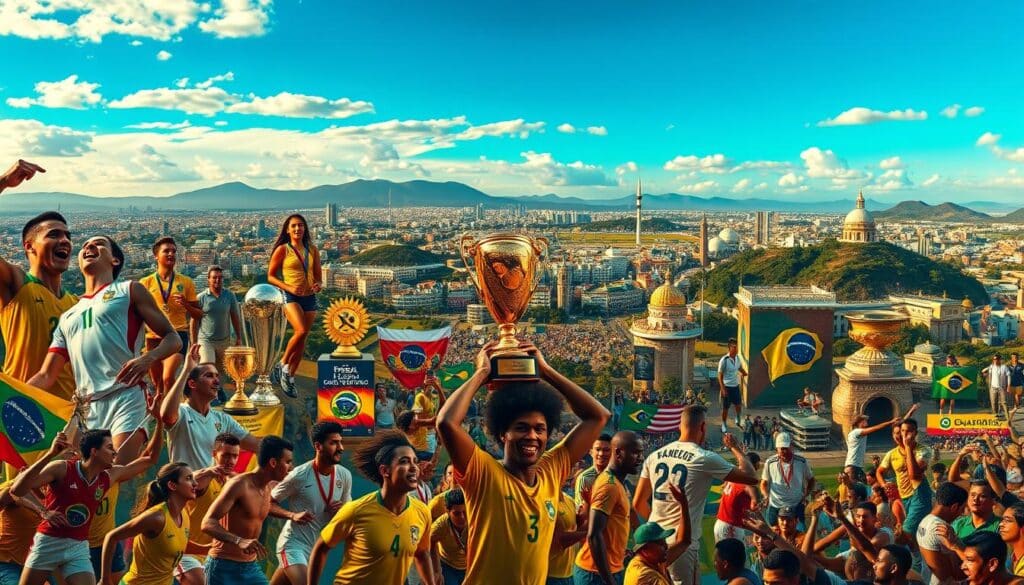
A history of Brazilian sport It is marked by major changes. It ranges from regional tournaments to famous national competitions. This trajectory has created a culture of winning that depends heavily on clubs and federations.
Evolution of national competitions in Brazil
National competitions evolved starting with specific tournaments. One example is the 1937 Tournament of Champions. Later, with the Taça Brasil and the Roberto Gomes Pedrosa Tournament, the effort was to unite clubs from all over Brazil.
Over time, the calendar evolved into the current format of the Brasileirão. The round-robin competition began in 2003, and since 2006 it has featured 20 teams. This has changed how trophies are won.
Unification of titles and recognition by the CBF and international entities.
The Brazilian Football Confederation (CBF) has decided to unify titles, merging the Taça Brasil and Robertão tournaments into the official competitions of the Brazilian Championship. They issued resolutions to formalize this decision.
Organizations like CONMEBOL and FIFA recognize certain competitions for statistical purposes and awards. Controversial cases, such as the 1987 Copa União, were decided by the courts.
Regional impact: São Paulo, Rio de Janeiro, and Minas Gerais on the bond map.
The distribution of titles by state This shows a big difference. São Paulo is in the lead, followed by Rio de Janeiro and Minas Gerais.
Clubs from São Paulo have won half of the Brazilian Championships, demonstrating the strength of their infrastructure and tradition. regional federations They play an important role in the training of athletes.
The title map indicates that the concentration of victories impacts several aspects. This includes rivalries, sponsorships, and the international fame of the clubs. This situation explains why some places have better results over the years.
Brazilian Championship champion clubs and main winners
The history of the Brazilian Championships is rich in traditions and rivalries. Clubs from São Paulo, Rio de Janeiro, and Minas Gerais stand out among the champions. This generates many debates about cycles of success.
Ranking of Brazilian Championship titles: Palmeiras, Santos, Flamengo and others
Palmeiras is the team with the most wins in the Brazilian Championship, having won 12 titles. Next are Santos and Flamengo, with eight wins each. Corinthians has seven and São Paulo, six.
- Palmeiras: 12 titles (highlight in Brazilian Championship ranking).
- Santos: 8 titles, with strong dominance in the 1960s.
- Flamengo: 8 titles, a strong presence in recent decades.
- Corinthians: 7 titles; São Paulo: 6 titles.
- Other champions: Cruzeiro, Fluminense, Vasco, Internacional, Botafogo, Bahia, Grêmio, Atlético-MG, Athletico-PR, Sport, Coritiba, Guarani.
Temporal distribution of achievements (decades with greatest dominance)
Decades reveal patterns of winners. In the 1960s, Santos and Palmeiras were the standouts. From 1970 to 1980, several states had champion clubs, increasing competitiveness.
In the 21st century, Palmeiras and Flamengo stood out again. Atlético-MG also had its moments of brilliance. This diversity shows how rich and varied Brazilian football is.
Clubs with trebles and historic streaks (e.g., São Paulo 2006–2008)
Winning streaks are common throughout history. São Paulo won three times in a row between 2006 and 2008. This feat is rare and impressive.
Santos had a golden era between 1961 and 1965, with many consecutive victories. These and other periods of success demonstrate Brazilian talent in football.
Additional national titles: Copa do Brasil and Supercopa de Rei
The Copa do Brasil has been surprising since 1989. It's a knockout competition that allows for broad participation. It has become a fast track to qualify for the World Cup. Libertadores. This tournament pits big clubs against smaller teams, creating memorable matches.
A King's Super Cup It returned to the calendar as a clash between champions. It pits the winner of the Brazilian Championship against the champion of the Copa do Brasil. This game is important for defining the strength and adjusting the national ranking between seasons.
Clubs with the most Brazilian Cups
- Cruzeiro stands out with an impressive history and six titles.
- Flamengo and Grêmio are always in the fight, making their presence felt with important victories.
- Palmeiras has accumulated trophies and played a leading role in decisive moments of the tournament.
Importance of the King's Super Cup
- It is a trophy that indicates superiority among national champions.
- A high-level match that increases the visibility and finances of the clubs.
- The clubs that have been winning recently are demonstrating their consistency in national football.
How the Copa do Brasil influences continental qualification spots.
The winner secures a direct spot in the World Cup. Libertadores. This changes how the vacancies of Libertadores They are distributed after the Brazilian Championship.
If the winner also qualifies through the Brasileirão, other teams may gain the chance to enter the competition. This affects who goes to the Libertadores and who participates in the Copa Sudamericana.
You supplementary national titles They bring balance to our sporting calendar. They show which teams will go to bigger competitions. Thus, they help to highlight the big teams. winners of the Copa do Brasil in the Brazilian football scene.
Total number of national and international titles by club.
This survey clearly shows the total number of titles per club. A total of 194 titles were counted: 120 national and 74 international. These were compiled by 26 clubs, following official and historical records. This helps us compare the national and international achievements of each team.
Palmeiras and Flamengo at the top.
Palmeiras leads with 24 major titles. The club has a collection of national and international trophies. This puts it ahead in many recent analyses.
Flamengo comes next, with 23 trophies. This proximity indicates fierce competition. It also highlights the rivalry between clubs from São Paulo, Rio, and other locations.
Club by club: comparison of levels
When comparing clubs, it's essential to separate titles by level. This includes world, intercontinental, continental, and national titles. This allows us to see the different levels of success of clubs on both the global and local stages.
- São Paulo: has won 20 titles; stands out on the international and world stage.
- Santos: has 17 titles in total; with a strong tradition of international achievements.
- Cruzeiro: also with 17 titles; shows a balance between national and continental titles.
- Corinthians: boasts 15 titles; has a strong presence in national competitions and world titles.
- Grêmio and Internacional are examples from the South of Brazil; they are prominent in continental and world tournaments.
Federations with the most titles
The titles are concentrated more in structured federations. A map by state illustrates the investment and talent development.
- São Paulo is in first place, with 80 trophies in total, including 7 world championships.
- Rio de Janeiro comes in second, with 46 titles.
- Minas Gerais has 28 trophies, while Rio Grande do Sul has 26.
This overview of titles by state And clubs demonstrate the impact of infrastructure and tradition. Thus, we can have rich debates about the history and future of football in Brazil.
Major international winners in Brazilian football.
Brazilian football has gained prominence abroad. Clubs from Brazil have won numerous titles in competitions around the world. They demonstrate their strength, management, and tradition.
Brazilian clubs have won the Copa Libertadores 24 times. They have also excelled in the Copa Sudamericana, Recopa Sudamericana, and Supercopa Sudamericana. These victories demonstrate the success of Brazilian clubs in South America.
H3: History of continental titles: Libertadores, Sudamericana and Recopa
- Libertadores: 24 trophies demonstrate the rivalry between the great clubs.
- Copa Sudamericana: important titles for clubs of all sizes.
- Recopa Sudamericana: Won 13 times by Brazilian clubs, demonstrating their strength.
H3: World and Intercontinental titles won by Brazilian clubs
Brazilian clubs have shone in the FIFA Club World Cup and the Intercontinental Cup. They have around 10 world titles and 6 intercontinental titles.
H3: Clubs that have stood out the most outside of Brazil
- São Paulo: with almost 12 international titles, including the World Cup and the Copa Libertadores.
- Santos: famous for its intercontinental and Libertadores victories with Pelé.
- Grêmio: known for its continental achievements and for reaching finals.
- Flamengo: has won several Libertadores titles and is always among the top title collectors.
- Internacional, Cruzeiro, Corinthians, and Atlético Mineiro: they also stand out in competitions around the world.
The sum of these awards shows how Brazilian football is admired internationally. Brazilian clubs have gained recognition from CONMEBOL and FIFA. They have made history with their victories in important tournaments.
Stars and top scorers: individual winners who made their mark on the Brazilian Championship.
The top scorers in the Brazilian Championship have left incredible marks. They became idols thanks to their goals that changed the history of clubs. A good center forward makes all the difference: the team's strategy and the fans' morale.
Historical goalscorers and their numbers
- Roberto Dinamite stands out with 190 goals. He leads the list of top scorers and demonstrates the importance of consistency.
- In the Santos team of the 1960s, Pelé shone. His goals secured national and even continental titles for the team.
- Romário He is a legend of the 90s. His talent and important goals marked the history of Vasco and Brazil.
Top scorers by season and memorable achievements
- Each year showcases a new top scorer from 1959 to 2024. These lists highlight the most impressive seasons.
- Washington scored 34 goals in one season, a recent record. His excellent performance caught everyone's attention in Brazil.
- Dimba, with 31 goals in 2003, and strikers who scored more than 20 goals demonstrate the high level of the championship.
How strikers influence club success
Having the best striker benefits the team in several ways. They help win difficult games, reduce pressure on the defense, and attract media attention. Teams that win titles usually have a decisive striker.
These players also increase the club's revenue. They bring in more money through ticket sales and sponsorships. Coaches take advantage of their talents, as Santos did with Pelé. In this way, they develop winning strategies.
The lists of top scorers in the Brazilian Championship tell stories of Brazilian football. Names like Roberto Dinamite, Pelé and Romário They are legends. They and other great players remain in the memory of the Brazilian people.
Winners in other sports: beyond football
Brazil shines not only in football, but also in other sports. Our country has won many titles in world and Olympic competitions. This demonstrates the strong performance of athletes and clubs in various disciplines.
Volleyball is a source of national pride. We have strong teams like Sada Cruzeiro and Minas Tênis Clube. They have won many international competitions.
These achievements stem from high-quality training and young talent. This keeps Brazil at the top of world volleyball.
Brazilian basketball has also had its moments of glory. We won medals in the Pan American Games and the Olympics. This increased the value of Brazilian basketball worldwide.
César Cielo raised the level of Brazilian swimming. We won important medals in championships around the world. This resulted in more investment in the sport.
In athletics, we had incredible performances, such as those of Thiago Braz and Fabiana Murer. They won medals that put Brazil in the spotlight.
- Brazilian Olympic champions demonstrate the strength of our sport.
- Our national teams and clubs have an excellent structure for competing internationally.
- Investing in training helps increase our victories in Olympic sports.
Participation in the Olympics and World Championships brings more visibility and sponsorships. This helps fund projects that continue to grow. And it also increases our fame in the sport.
Not only in football, but in various sports, Brazilians excel. But the number of titles varies. Sometimes it's more about the athletes than the clubs. This affects how we value our champions.
Profiles of the biggest winners: stories and legacies.
Winning players and teams left behind more than just trophies. Their performances influenced the national sporting culture. See the profiles and stories that made them icons.
-
Pelé led Santos and the national team during their golden era. His impact goes beyond victories; he is a global symbol of Brazilian football.
-
Zico stood out at Flamengo as a playmaker and goalscorer. His achievements reflect his skill and influence both at the club and in the national team.
-
Garrincha is remembered for his dribbling skills and unforgettable World Cup performances. His story is one of overcoming adversity and magic, thrilling generations.
Historic teams and championship-winning squads
-
The Santos team of the 1960s, with Pelé, Coutinho, and Pepe, changed South American football, winning important titles.
-
Palmeiras has had successful periods at different times. These winning streaks have marked the history of Brazilian football.
-
Cruzeiro has excelled in several seasons, shining in the Copa Libertadores and the Brazilian Championship. The club is known for its competitiveness and for developing talented players.
-
In the late 2000s, São Paulo experienced a victorious period. Their team achieved important victories in local and continental tournaments.
Social and cultural legacy
The triumphs of players and teams have influenced communities, grown fan bases, and stimulated the football market. This growth has been accompanied by live broadcasts, sponsorships, and cultural products.
Social projects run by clubs have used the fame of champions to promote inclusion and sporting development. These initiatives have enriched the cultural legacy of football in Brazil, integrating it into our identity.
The combination of success and history made these winners Symbols in museums, books, and family memories. They influence our daily lives, celebrations, and the pride we feel for our regions.
Geographic distribution of titles and influence of federations
The distribution of trophies among the states reveals important patterns in Brazilian football. The numbers show the strength of the local federations and how much they invest in infrastructure. They help to understand why some clubs win so much over time.
Data by state and the role of federations
- São Paulo is at the top with 50 national titles and 30 international titles, totaling 80. This shows São Paulo as the main center, with strong teams like Palmeiras and Corinthians.
- Rio de Janeiro has 30 national titles and 16 international titles, totaling 46. Teams like Flamengo and Vasco highlight the importance of the local federation.
- Minas Gerais boasts 17 national titles and 11 international titles, totaling 28. Atlético Mineiro and Cruzeiro contribute significantly to this number.
- Rio Grande do Sul has 13 national titles and 13 international titles, totaling 26. Internacional and Grêmio are the standouts.
Comparison between centers
The match between Rio, Minas Gerais, and Rio Grande do Sul highlights important differences. States with more competitive teams win more titles. This shows how the federations influence the success of the teams.
Training centers and infrastructure
There is a clear correlation between good training centers and success. Teams from São Paulo and Rio invest heavily in their training centers. This helps to consistently produce high-level athletes.
Impact of champion federations
Federations with good football academies and professional management help teams win. They guarantee more frequent victories and help to discover new talent. novos talentos.
Practical summary
- The distribution of the titles reflects the investment and tradition of each state.
- São Paulo stands out, concentrating the majority of the titles.
- The infrastructure for training athletes is essential for success.
- The federations support the teams in their pursuit of national success.
Statistics and interesting facts about the biggest winners.
This text discusses the most successful football clubs in Brazil. It showcases their history of achievements, both domestically and internationally. It's an interesting read for anyone who enjoys football.
So far, 26 clubs have won 120 national titles and 74 international titles. São Paulo and Rio de Janeiro are very representative states in this count.
-
Palmeiras and Flamengo are the clubs with the most titles. They excel in both national and international competitions.
-
Smaller clubs also have important titles. This shows that any team can make history.
Guarani in 1978 and Chapecoense in 2016 are examples of memorable achievements. They prove that in football, anything is possible.
-
In 1920, Paulistano won an important championship despite being an amateur club. That's rare and interesting.
-
Grêmio Maringá won a unique tournament, which generates a lot of curiosity in Brazilian football.
-
Criciúma and Santo André won the Copa do Brasil, breaking with tradition. It was a great surprise for the sport.
Changes in championship rules also influence the counting of titles. For example, the unification of championships in 2010.
The history of the 1987 Copa União still generates debate. The CBF (Brazilian Football Confederation) has also recognized older tournaments, which is interesting for the history of football.
-
The way the championships are organized has greatly affected the clubs. They have had to adapt their strategies.
-
The tournament rules have changed several times. This has caused some titles to change in value.
-
Clubs that surprised everyone by winning championships show that money isn't everything in football.
Surprising victories and unique stories enrich Brazilian football. This information is great for anyone who researches or enjoys discussing football.
Winners: Analysis, trends and predictions for the future
Brazilian football is changing, blending the old with the new. Well-managed clubs with money are in the lead. But innovative projects are also emerging. These changes impact who wins the Brasileirão (Brazilian Championship).
Recent trends
- Teams like Palmeiras, Flamengo, Atlético-MG, and Corinthians are standing out. They invest in players and improve their facilities.
- Clubs are becoming more professional. This is evident in their scouting, marketing, and youth development departments.
- With more TV money and sponsorships, some teams become stronger. This changes the competition in the Brasileirão and the Copa do Brasil.
Impact of regulations and the market
- The points-based system values consistency and good management. This makes it difficult for smaller teams to rise quickly.
- Financial rules and calendar changes affect how clubs can spend and buy players.
- The Copa do Brasil is a chance for smaller teams. They can gain visibility and money.
Predictions for the next decade
- Clubs with good management and control of their finances will continue to lead. Teams like Palmeiras, Flamengo, and São Paulo are in the lead.
- Projects like Red Bull Bragantino show that new management styles can create champions. This should continue to happen.
- Some surprises will come from clubs that invest in their youth academies and have good management. This could give them an advantage.
- International competition is set to intensify. Investments are growing, and everyone wants a spot in the Copa Libertadores and the Club World Cup.
This scenario shows that planning and having money are just as important as talent. Those who balance tradition and innovation will have a better chance of winning.
Conclusion
This summary shows the history of Brazilian champions, We highlight important clubs and athletes. We talk about the growth of football in the country. We look at the main clubs, such as Palmeiras and Flamengo, and their many trophies.
We also consider the importance of São Paulo as a sporting hub. States like Rio de Janeiro and Minas Gerais also stand out in the development of players.
Looking to the future, we see that smaller clubs have a chance to grow. This can happen with good management and investment. We encourage Reading more data from CBF and CONMEBOL.
FAQ
What does this survey about the greatest Brazilian winners in sports cover?
This work showcases Brazil's greatest sporting achievements, with a focus on football. It includes rankings for the Brazilian Championship, Copa do Brasil, and others. It also covers volleyball, basketball, swimming, and athletics. The information comes from official sources such as the CBF, CONMEBOL, FIFA, and others.
Which football competitions have been unified or officially recognized by the CBF?
The Brazilian Football Confederation (CBF) unified competitions such as the Taça Brasil and the Torneio Roberto Gomes Pedrosa. It also recognized other historical tournaments. These decisions occurred in 2010 and 2023. All listed competitions are officially recognized. Furthermore, the 1987 Copa União had Sport recognized as champion by the Supreme Federal Court (STF).
Who is the most successful team in the Brazilian Championship according to this survey?
According to this study, Palmeiras is the most successful club in the Brazilian Championship, with 12 titles. Santos and Flamengo follow closely behind, with eight titles each. Corinthians and São Paulo are other clubs with numerous victories.
How has the Brazilian Championship evolved into its current format?
The path to the modern Brasileirão (Brazilian Championship) passed through many milestones. Among them, the 1937 Tournament of Champions, the Taça Brasil (Brazil Cup), and the Roberto Gomes Pedrosa Tournament. Since 2003, the championship has been played in a round-robin format with 20 teams.
What is the regional distribution of national and international titles?
Most of the titles are in the Southeast region. São Paulo leads with 80 titles. Then comes Rio de Janeiro with 46 and Minas Gerais with 28. This shows the strength of the clubs from these regions.
How does the survey treat the total number of national and international titles per club?
He adds up the national and international titles of each club. This includes competitions such as the Brasileirão and the Libertadores. Palmeiras and Flamengo are at the top, with a total of 194 titles among 26 clubs.
Which clubs stand out in the overall title ranking?
At the top is Palmeiras, followed by Flamengo and São Paulo. Santos, Cruzeiro, Corinthians, Grêmio, and Internacional are also prominent. The list considers all levels of competition.
How many editions of the Copa Libertadores have been won by Brazilian clubs?
Brazilian clubs have won the Copa Libertadores 24 times. Among the champions are São Paulo, Santos, Grêmio, and others.
Who are the all-time top scorers in the Brazilian Championship and what records do they hold?
Roberto Dinamite is the all-time leading goalscorer, with 190 goals. Pelé, Romário Zico is also on the list. Washington scored 34 goals in a season in 2004. More recently, Paulinho and Germán Cano have been standouts.
What is the relationship between having a top scorer of the season and the club's success?
Clubs with prolific goalscorers are usually successful. Pelé at Santos is an example. But having a top scorer doesn't guarantee titles. Teamwork and management are also important.
How does the Copa do Brasil affect qualification for continental competitions?
The Copa do Brasil champion goes directly to the Libertadores. This changes the spots for the Copa Sudamericana and affects the national ranking. These results influence the 12 continental spots available.
What is the King's Super Cup and why is it important?
A King's Super Cup, The Copa do Brasil, a tribute to Pelé, brings together the champions of the Brazilian Championship and the Copa do Brasil. Since 2020, it has been an important trophy. Winners make history.
Which clubs have had memorable historical cycles or sequences?
Santos, Palmeiras, and São Paulo all had important winning streaks. They are remembered for their achievements in different eras.
Does the survey cover winners outside of football?
Yes. It includes achievements in volleyball, basketball, swimming, and track and field. Sports celebrities like César Cielo and Thiago Braz are highlighted.
How do training centers and infrastructure influence the production of winners?
More investment in youth development leads to more titles. Clubs in São Paulo and Rio have advantages due to their infrastructure and financial support.
Are there examples of unexpected titles or singular champions in the sport?
Yes. There are stories of overcoming adversity and unique titles like those of Guarani, Chapecoense, Criciúma, and Santo André. These moments are special in Brazilian football.
What are the trends and predictions for the next decade in Brazilian football?
Well-managed clubs are expected to remain at the top. Projects with foreign investment are expected to grow. Competition will become more intense.
Where can the reader check the sources and delve deeper into the data presented?
For more information, consult the CBF, CONMEBOL, FIFA, and club archives. Sports institutions also publish reliable data.
Content created with Artificial Intelligence Assistance