
Adverts
What type of hair do you like best?




Dating apps have revolutionized how people around the world meet through Tinder, Bumble, and Happn. Research from Happn indicates that 451% of singles have already made friends through these platforms. This shows that these apps go beyond romance. They create bonds that may last a long time or a short time, but are always positive.
In terms of usability, simplicity is key. News outlets like Estado de Minas highlight the ease of registration and password recovery. This ease of use helps many people adopt these apps. It makes the online dating experience safer and more practical for everyone.
Why are dating apps popular in Brazil?
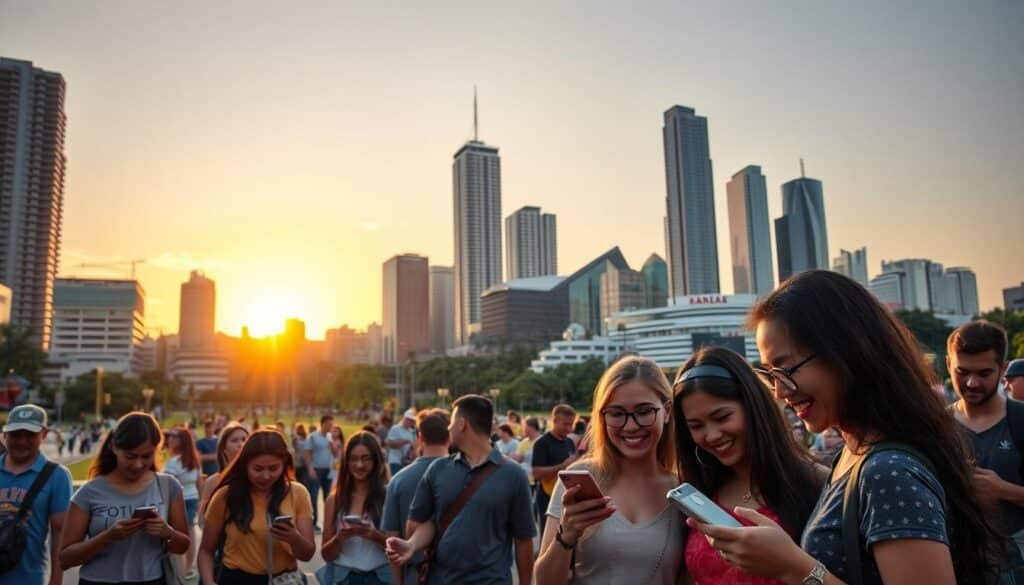
The growing adoption of these services shows a shift in how we connect. Dating apps in Brazil are popular because they facilitate technology. They make it easier to find new connections in our daily lives.
Usage trends among different age groups
A study by happn highlights the differences in usage by age. People over 36 use the apps for friendships and support. Young women, between 18 and 25 years old, like more profiles seeking friendship, reaching 61%.
This difference needs attention on the platforms. Adapting profiles, filters, and messages makes apps more relevant, improving the user experience.
How does the naturalization of use affect society?
Today, it's rare to find someone looking for companionship who doesn't use dating apps. They've become commonplace for both shy and extroverted people.
Apps expand our social networks and reduce prejudice. They allow us to meet different people, changing the rules of dating and friendship in society.
Data from recent research on user behavior
Recent studies point to new user expectations. According to research by happn, 48% are open to friendships, not just romance.
Furthermore, 36% said that affinity is crucial. Being clear about what you're looking for is fundamental for 73% users.
From a technical standpoint, easy registration and intuitive interfaces make all the difference. They help keep users safe and confident, making apps a popular choice in Brazil.
Connections beyond romance: friendship and social networks in apps.
Dating apps in Brazil are now used for more than just romance. They've become places to find like-minded people, share ideas, and create groups for fun. This new trend shows that users are looking for everything from casual flings to simple friendships.
Percentage of Brazilians who made friends on dating apps.
A study by happn revealed that 451,300 singles in Brazil have already found friends on dating apps. Furthermore, 481,300 are open to meeting people in a non-romantic way, highlighting the power of social networks within these apps.
Motivations for seeking friendships instead of romance.
Almost half of users seek relaxed interactions, without the pressure of emotional involvement. Around 41% admitted to liking profiles with the goal of making new friends. This is more common among young women, aged 18 to 25, where the number reaches 61%.
They seek uncomplicated conversations, mutual interests, and similar lifestyles. This desire explains why some people prefer friendships to romantic relationships before getting seriously involved.
Favorite activities and meetups among friends who met on apps.
Favorite activities among friends who met through apps vary. The most popular are:
- 29%: going to bars, cafes and restaurants
- 19%: taking tours around the city
- 15%: watching series together
- Other options include: taking short trips, going to the movies, and developing casual friendships.
These choices show that apps generate real connections, going beyond dating. Approximately 151,300 of these friendships turned into relationships. Among men over 36, that number rises to 211,300, according to the research.
Inclusion and outreach: bringing people from different backgrounds closer together.
Dating apps have changed the way people meet. They allow people of different ages, cities, and lifestyles to connect, even when in-person meetings aren't possible. Targeted platforms make it easier by clarifying objectives, allowing everyone to find their ideal connection.
Examples of unlikely encounters that only happened through dating apps.
Jairo, 45, from Porto Alegre, met Fernanda, 24, from Criciúma, on Meu Patrocínio. They got together and started a family. Without the apps, their lives would hardly have crossed paths due to the age and city differences.
Cases like Jairo and Fernanda's prove that unexpected encounters can turn into lasting relationships. This happens when intentions are clear from the start. Technology, then, has the power to unite people whom daily life would otherwise separate.
How geography and lifestyle cease to be barriers.
With apps, you can search by location and personal preferences. This way, even those who don't go out much or have busy lives can find partners online.
Searching on apps reduces the distance between people. This makes it easy to find someone with similar interests and routines. It's inclusion in the world of dating apps.
Real-life cases that illustrate the diversity of profiles.
My Sponsorship Brazil This is an example of a website with over 500,000 users. It separates users into Sugar Babies and Sugar Daddies. This makes everything clearer and helps with agreements between the parties.
This way of organizing users shows how it's possible to increase inclusion. It also creates opportunities for families, friendships, and partnerships to emerge that would otherwise be unlikely.
- Greater access to social networks outside of one's own city.
- Varied profiles representing different social classes and styles.
- Transparency in intentions to reduce misunderstandings.
Filtering and screening tools: saving time and ensuring safety.
Filters and screening options have improved how Brazilians search for connections. Sites like Tinder, Bumble, and Meu Patrocínio allow users to choose by age, location, interests, and what the person wants. This makes searching for a compatible partner more direct and less tiring.
How filters help find compatible profiles
The filters on dating apps speed things up by showing only those who match what you're looking for. Whether it's for friendship, dating, or something casual, it's easier to find profiles that match your desires. Choosing by lifestyle helps you find people with similar interests.
Security and profile verification functions
Websites are becoming increasingly secure, investing in verifying who registers. They use everything from photos to documents to prove a person's identity. They also have options to block and report users, making online browsing safer.
Impact on reducing unwanted encounters and wasted time.
Screening helps reduce contacts that aren't relevant to you. People see fewer bad matches when using filters and verification. It becomes easy to avoid conversations when everyone's intentions are clear.
- Use filters for age, location, and intent.
- Activate profile verification whenever available.
- Combine technical skills with personal precautions: avoid meetings in public places and inform someone you trust.
Transparency and setting expectations in profiles.
Having clear profiles avoids frustration and helps you make better connections quickly. By clearly showing what you're looking for, it's easy to find matching profiles and save time. As happn revealed, 73% of its users find transparency important from the start.
Why make the type of relationship clear?
- Clarifying whether you're looking for friendship, a romantic relationship, or something casual prevents misunderstandings.
- It encourages honest and respectful interactions right from the start.
- Set boundaries and expectations even before the first date.
How intent options help
Profiles allow users to indicate whether they are looking for friendship, dating, or something casual. This directly defines what is expected from online dating. Intent tools help avoid incompatible matches. Platforms like Meu Patrocínio use categories and filters to ensure that people have aligned goals.
Benefits for different age groups
- Young people save time by focusing on profiles with similar interests.
- Older adults have greater safety and less risk of misunderstandings when intentions are clear.
- People with busy schedules find it easier to connect with profiles that share the same goals.
Practical tips
- Describe yourself objectively to make profiles more transparent.
- Choose intent options when the app offers them.
- Keep your profile updated as your goals change.
Having honest and well-thought-out profiles makes online dating work better. Starting by defining what you want avoids confusion and makes interactions safer and more enjoyable, for both young and old.
Authenticity and more relaxed conversations without romantic pressure.
On dating apps, the lack of pressure to date helps create more genuine connections. People feel more comfortable and are more themselves. According to happn, 48% users feel that conversations flow more easily without the pressure of romance.
When you talk about hobbies or daily life, conversations become more spontaneous. Exchanging messages about TV series or routines creates a connection. This makes online flirting lighter and more friendly.
Common ground emerges quickly in interactions. Lifestyle, humor, and shared interests are important. Well-crafted profiles are essential for discovering these interests and the other person's sense of humor.
- Spontaneous messages explore humor and culture.
- Photos and descriptions show daily life, making the choice easier.
- Responding quickly and lightly prevents the conversation from becoming forced.
Without the pressure to impress, people are less anxious. Users value honesty and can create genuine bonds. Happn says that 151% of friendships turn into romantic relationships, showing that authenticity can create strong connections.
The role of apps for shy people or those with restricted routines.
Apps help those who fear rejection or have busy schedules. They offer a less daunting way to meet new people. You can chat slowly, see if there's a connection, and choose the right time to meet someone.
They are a good refuge after a broken heart, experts say. Making the selection ahead of time helps reduce anxiety. It also makes it easier to find someone who matches you and makes you feel more secure in online dating.
Profiles and filters focus on common interests and principles.
Initial messages can help avoid awkward encounters.
Verification and review features add extra security.
How apps function as a safe environment for flirting.
On Tinder, Bumble, and Hinge, privacy is taken seriously. They allow you to control who sees your profile. This way, online dating remains safe until you feel comfortable.
An alternative for those who don't frequent bars or parties.
Many people find their partner without needing to go to nightclubs. Apps connect people from different backgrounds and cities, expanding their options.
Reports from users who initiated relationships outside their usual social environment.
Jairo and Fernanda met through an app and lived in different cities. They arranged to meet whenever they could, away from the noise.
A young woman, who identifies as a sugar baby, uses the app to clearly define what she wants. She says this helps her maintain emotional control, distancing herself from those who don't share the same goals.
Psychologists warn that care must be taken not to become intolerant or to dismiss people too quickly. Balancing virtual conversation and real-life meetings is crucial. This can transform an online conversation into a real relationship, far from the bars.
Apps as a platform for different types of relationships.
Today, dating apps help people find various types of companionship. They range from traditional dating to open relationships. They also include friendships with benefits and well-defined agreements between the parties.
Traditional dating, casual relationships, and partnerships with explicit agreements.
On these apps, you can find both dating and casual relationships. This means that everyone can say what they're looking for. This makes it easier to find profiles that match your expectations.
When everyone is clear about what they want, the right matches happen more easily. There are profiles looking for commitment and others just wanting casual fun.
Cases involving specialized platforms (e.g., Meu Patrocínio) and aligned expectations.
On platforms like Meu Patrocínio, the agreements are clear from the start. These sites are designed for audiences seeking specific arrangements.
This brings clarity and reduces frustration. Those who use these services know what to expect and can act more directly in negotiations.
Advantages of having segmented spaces for different purposes.
- Searching becomes more efficient when profiles have similar goals.
- Speaking clearly about what you are looking for reduces wasted time.
- Segmented spaces provide emotional support by establishing boundaries from the start.
Having targeted apps makes all the difference when searching for relationships. This is because it allows you to find the type of relationship you want, whether it's dating, friends with benefits, or specific arrangements.
Positive emotional impact: self-esteem, social skills, and learning.
Using dating apps can be good for your feelings when people are clear and respectful of each other. Communicating positively helps express feelings in different ways, without the stress of being in person. This improves trust and helps you grow as a person.
Exchanging messages and having fun on dates is good for how we feel about ourselves. Many say they feel more comfortable starting conversations in places like work or parties. Having success online gives you the courage to arrange in-person meetings.
Learning about communication, boundaries, and emotional negotiation.
- Platforms teach how to communicate feelings by testing the right way and time to speak.
- Talking about what you expect helps to set boundaries. This reduces confusion before actually meeting.
- Expert Marina Vasco says that knowing how to deal with both good and bad situations makes a person emotionally stronger.
Risks are reduced when there is prior selection and more conscious exchanges.
Choosing people based on similar interests reduces frustration. This choice makes the impact of online dating less painful. Even so, some warn: imagining someone's profile too much can be frustrating if the image isn't real.
In short, online dating can improve our relationships and teach us how to deal with our feelings. Being clear about our intentions and always learning makes each interaction a chance for personal growth.
Data and research that prove the benefits of apps in Brazil.
Recent studies highlight how dating apps have changed the way we relate to each other. They present data on friendships, intentions, and changes in relationships.
Happn revealed important aspects of connections beyond romance. It was found that 451% of single Brazilians made friends through these apps. Furthermore, 41% liked profiles of people looking for friends, and 48% are open to meeting people without romantic interest.
The data also reveals what people value when starting a conversation. Approximately 36% prefer relationships based on shared interests. And 73% believe it is essential to clarify intentions from the beginning, avoiding misunderstandings.
Below are some figures on how these interactions affect real life.
- 15% of friendships made on apps turned into romantic relationships.
- 21% of men over 36 years old had a serious relationship that started on an app.
- 61% of women aged 18 to 25 use apps to find friendships.
These numbers show different trends across age groups and genders. People over 36 tend to develop friendships that turn into serious relationships. Young women, on the other hand, seek to create circles of friendship and support.
When comparing happn's data with other research, it becomes clear that apps have varied uses. Expectations change according to age, gender, and people's desires.
Analyzing this information helps create better usage strategies. Marketing professionals and app designers can adjust their tools to better meet user needs, based on relationship statistics.
Conclusion
Data reveals that dating apps do more than just bring couples together. Platforms like happn and other specialized ones show this. Many in Brazil find friends and expand their networks. These spaces can create surprising connections between people from different worlds.
When discussing the positive aspects of dating apps in Brazil, we see that they save time and provide greater security. Research shows that 451% of people have made friends this way. Furthermore, 48% are open to non-romantic relationships, and 15% of these friendships have turned into romantic relationships. This demonstrates the effectiveness of these features.
To get the most out of these benefits, it's good to be honest in your profile, use safety measures, and find a balance between online conversation and face-to-face meetings. Using these apps carefully and being emotionally ready can open new doors for affection and friendship in Brazil, improving how we feel and our connections with others.
FAQ
What are the main positive impacts of dating apps on the social and romantic lives of Brazilians?
Dating apps help expand social circles and meet different people. According to happn, 451% of singles in Brazil have made friends through these apps. And 481% of those are open to friendships, not just romance.
They also create space for more genuine conversations. This can reduce social anxiety and improve your interaction skills.
Why have dating apps become so popular in Brazil?
The popularity of these apps stems from their ease of use, reach, and general acceptance. Platforms like Meu Patrocínio and happn make it easy to meet new people, with filters for location and interests. Today, people of all ages use these apps to find companionship.
Is there a difference in how different age groups use apps?
Yes. People aged 36 and older tend to seek friendships. Young women, between 18 and 25 years old, like profiles seeking friendship in 611% of cases. This shows how age and gender influence the use of dating apps.
How does the normalization of drug use affect society and its stigmas?
As their use becomes more common, prejudices about online dating diminish. Thus, apps become part of everyday life for both shy and extroverted people. They facilitate the search for friendships or more serious relationships, increasing inclusion and diversity.
How many Brazilians have made friends through dating apps?
Around 451,300 singles in Brazil made friends through these apps, reveals happn. Furthermore, 151,300 of these friendships turned into romantic relationships, a number that rises to 211,300 among men over 36 years old.
What are the motivations for seeking friendship instead of romance on dating apps?
Many prefer to chat without the burden of romantic expectations. They seek common interests or simply companionship for activities. According to happn, 41% liked profiles seeking friendship, wanting light and genuine interactions.
What activities typically arise between friendships formed on dating apps?
Friendships made through dating apps often lead to meeting up at bars, cafes, or restaurants. They also enjoy going for walks or watching TV series together. Travel and movies are other popular activities.
Can apps bring people from different cities and realities closer together?
Yes. With the help of technology, these apps make unusual encounters possible. For example, Jairo and Fernanda, who are from different cities, met this way. They became an example of how platforms facilitate these connections.
How do geography and lifestyle cease to be barriers?
These apps allow you to search for people nearby or with similar lifestyles. This makes it easier to find partners, even for those who don't go out much. Thus, technology overcomes physical and social barriers.
Are there examples of platforms that cater to specific niches?
Yes. One example is Meu Patrocínio, which has over half a million users. It connects Sugar Babies and Sugar Daddies clearly, avoiding misunderstandings and making it easier to find someone with similar goals.
How do filters help find compatible profiles?
Filters make searching faster and more accurate. They eliminate profiles that don't match and focus on those that are most likely to be interesting. This helps you find someone with similar interests and goals more easily.
What security mechanisms do apps typically offer?
Many apps have profile verification, blocking options, and a reporting system. They also provide safety tips for dating. While this doesn't eliminate all risk, it increases confidence in arranging dates.
Do filters reduce unwanted encounters?
Yes, choosing beforehand reduces the chances of bad dates and saves time. This makes it easier to focus on who really interests you. However, caution and good practices are still recommended during real-life dates.
Why is it important to clearly state your employment status in your profile?
Being clear helps avoid disappointment. Happn says that 731% of its users find it important to state what they are looking for from the start. This aligns expectations, making the process more direct and efficient.
How do descriptions and intent options help both older adults and young people?
Clear profiles prevent confusion and streamline connections between people with similar interests. Both seniors and young people benefit, finding more compatible partners and saving time.
Why do conversations often flow better without romantic pressure?
Without the pressure of romance, conversations are more authentic and lighthearted. Happn observed that 48% of users feel this makes communication more natural. This helps build honest and lasting relationships.
What factors act as triggers for affinity between users?
Humor, similar lifestyles, and shared interests are triggers for connection. Well-crafted profiles highlight these qualities, making it easier to find someone who truly matches you.
What are the positive outcomes when there is no pressure for affective performance?
Authentic, anxiety-free conversations improve the chances of friendships or dating. Happn shows that 151% of friendships turn into romantic relationships. This indicates that relationships evolve in a healthy way.
How do apps help shy people or those recovering from heartbreak?
For shy people, apps are a safe way to try new interactions. Those who are dating again find a space to rebuild social confidence. Both can control the pace of the conversations.
Are apps an alternative for those who don't go to parties or bars?
Yes. They're great for those who prefer to avoid traditional meeting places. That way, even with different schedules, it's easier to find someone who matches you.
Are there any real accounts of people who formed relationships outside of their usual social environment?
Cases like Jairo and Fernanda's illustrate how apps can connect people from different backgrounds. They show that it's possible to form family and romantic relationships outside of the usual environment.
What types of relationships do apps accommodate?
The apps cover a variety of relationships, from serious dating to casual flings. They offer spaces for different types of connections, adapting to the needs of the users.
What are the advantages of segmented platforms like Meu Patrocínio?
Targeted platforms connect people with similar interests. For example, Meu Patrocínio makes it easier to find Sugar Babies or Sugar Daddies, making searches more effective and reducing frustration.
How can apps contribute to self-esteem and social skills?
Success in online interactions increases confidence for face-to-face meetings. It also expands how we express ourselves, negotiate boundaries, and build safe relationships.
What emotional lessons do users typically develop?
Users learn to set boundaries, negotiate expectations, and recognize compatibility. This leads to healthier and more realistic choices in relationships.
Are the risks completely eliminated by pre-selection?
Although screening and clarity reduce bad encounters, risks still exist. It's essential to balance virtual encounters with safe, real-life meetings.
What are the key figures from happn's survey on friendships and connections?
According to happn, 451% of single Brazilians made friends on dating apps. Furthermore, 48% are open to non-romantic friendships, and 41% liked profiles with that intention. Another 73% emphasize the importance of declaring the type of relationship from the beginning. And 15% of these friendships evolved into romantic relationships.
How to interpret trends by age group and gender in the data?
Data shows that people over 36 prefer making friends. Young women seek more friendships, and the chance of dating varies according to age and gender. This reveals the versatility of dating apps in meeting different desires.
What practical recommendations can help you get the most out of apps?
It's important to be clear about your intentions, use safety measures, and meet in public places. Balancing online interactions with in-person experiences is also vital. These practices improve the chances of meaningful and safe connections.
Do apps truly expand social inclusion and emotional opportunities in Brazil?
Yes. Apps like Meu Patrocínio and happn show that there is an increase in opportunities to make friends and connect with different people. Used responsibly, they can enrich our social and romantic lives.
Content created with Artificial Intelligence Assistance